
At the University of South Carolina, students gain knowledge and skills they’ll need for the future. Some come to campus with a career already in mind, while others come hoping to find their direction. Facing a competitive job market after graduation, many consider an internship to be an indispensable part of their college experience.
And it’s not just about building a resumé. Paid internships offer students the opportunity to find their passion and earn valuable experience. From health care to sports, state government to local business, USC’s student interns explore a variety of career paths and hone professional skills that will serve them in any field.
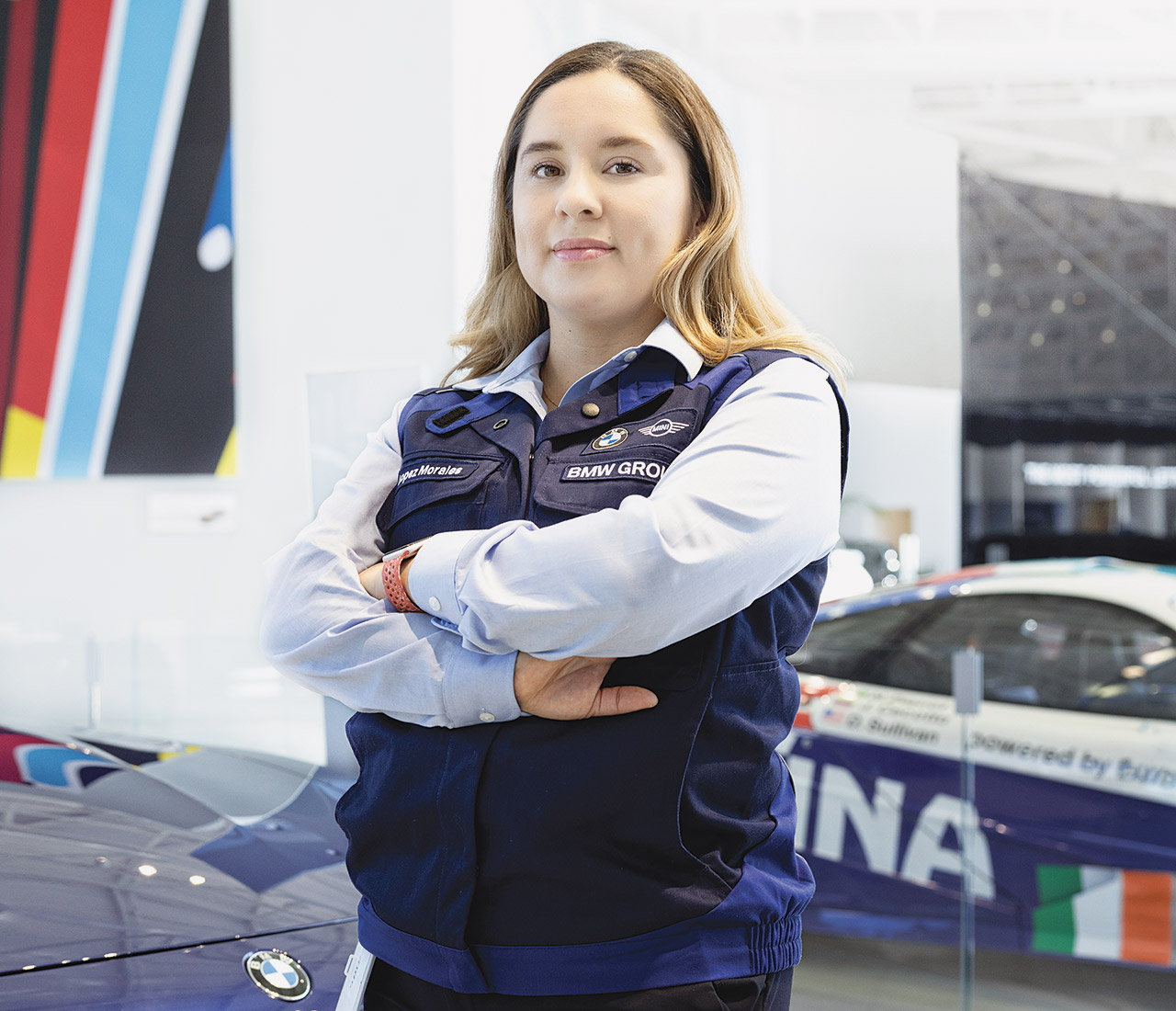
As she was growing up, Katherine Lopez Morales remembers taking vacations to South Carolina. Originally from Ecuador, Lopez Morales and her family took in the sights and spent time with relatives who live in the Upstate. She especially remembers catching a glimpse of BMW’s Zentrum, the automotive manufacturer’s museum and visitors’ center, from I-85.
“BMW was always a big deal in South Carolina,” she says. “When I moved here and started college, I kept my eye out for any openings at BMW.”
Lopez Morales is a senior at USC Upstate earning her degree in accounting. For her final semester, she landed an internship at BMW’s Plant X, or 10, in Spartanburg County. She works 40 hours a week with the accounting department team, collaborating closely and gaining insight into various aspects of corporate accounting through each project.
“When I first started, I was working with the accounts payable area, and now I’ve had the opportunity to be involved with areas like inventory and fixed assets. Throughout my internship, I’m gaining a broad understanding of the different parts of the department,” she says. “The coolest part has been touring the manufacturing side of the company. Seeing how each stage of production connects to the financial side has been incredibly interesting.”
After graduating from USC Upstate, Lopez Morales will start her master’s in accounting at the Darla Moore School of Business in Columbia, preparing to become a Certified Public Accountant. The experience at BMW has shown her that she would enjoy working in the corporate or manufacturing world. If she could do it over again, Lopez Morales says she would go for an internship sooner.
“USC Upstate did a good job of sending us emails reminding us to go to career fairs and apply for internships,” she says. “But it didn’t catch my attention as something I, personally, should do.”
As a non-traditional college student, Lopez Morales was already working fulltime. After moving to the U.S. in 2018, she took English as second language classes and then earned her associate’s degree, all while starting a family. Transferring to USC Upstate as a junior offered her an opportunity to take her education and career to the next level.
“It’s like their slogan says: ‘Reach Greater Heights.’ I’ve definitely done that here,” she says.
Lopez Morales has also benefitted from USC’s South Carolina Internship Program, which supports students pursuing internships in high-demand industries across the state.
“I think it’s great that USC offers program like this that help students to grow professionally while getting hands-on experience,” she says.
Lopez Morales has been able to juggle her course load, family and internship successfully, though she says some student may need to take a semester off to manage the required 40-hour work week at BMW.
“I’m lucky my class schedule is manageable this semester,” she says. “But I think an internship is worth it. It’s essential to get experience beyond your books — to learn what the real world looks like. As long as you practice good time-management skills, you can succeed.”

Basketball was first for Lydia Gattozzi. The Chardon, Ohio, native started her college career as a small forward for the Canisius University Griffins in Buffalo, New York, but she transferred to USC Beaufort after two seasons.
It was a smart move. She missed the 2023-24 season with an ACL injury but bounced back. The fifth-year senior finished the regular season in 2025-26 averaging 15.2 points and 4.5 rebounds per game. She has been named team captain by Sand Sharks Head Coach Sharon Versyp for three straight seasons.
But it’s the off-court experience Gattozzi is banking on. Since arriving in Beaufort, the communications studies major, sport management minor, has interned in USCB’s Office of Advancement and served as vice president, then president, of the Student-Athlete Advisory Committee. One of her professors also helped her land a job with the Savannah Bananas broadcast team, Bananas TV.
“Academically, I’ve been connected with amazing professors at USCB that have really pushed me and brought a lot of opportunities to the table, and I’ve jumped on those opportunities,” she says.
And then there’s her internship with USCB Career Services. For 10 hours a week — when she’s not in the classroom, on the court or running the score bug for the Bananas — Gattozzi creates and edits video content designed to help other USCB students figure out their own career paths.
“I’ve learned more about creating content that keeps people engaged,” she says. “People pay attention more if you keep it moving, if there’s something constantly going on on screen.”
But Gattozzi isn’t just sharpening her camera and video editing skills. This spring, she also has been helping Career Services prepare for USCB’s job fair. The experience has provided fresh opportunities that will benefit her when she begins the master’s in mass communications program at USC’s College of Information and Communications in Columbia this fall.
“I’ve made a ton of connections, and I think that’s the most important thing when you’re doing an internship or have a new job,” she says. “And working with Career Services, I also get to hear the tidbits and the pointers that they give to other students.”
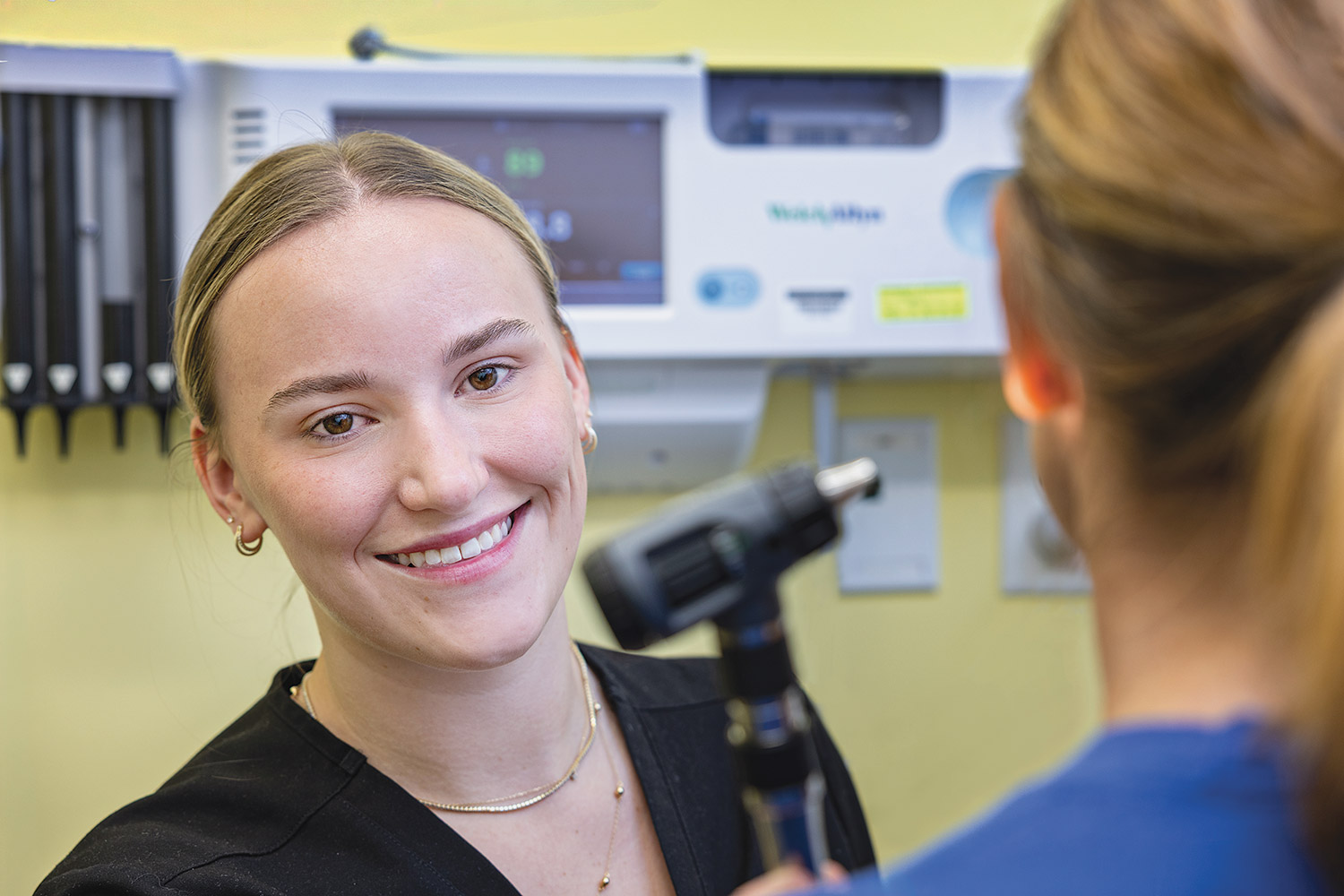
Riley Smith knew she wanted to go premed when she started college. The question: Which field of medicine should she pursue? “I thought about going to medical school, but I realized I wanted to get into patient care a little faster, so I’m applying to P.A. schools now,” she says.
Physician assistant programs provide a broad medical education to future practitioners. This works well for Smith. The senior biology major in the South Carolina Honors College wants to keep her options open.
This spring, she has been working part time as a medical assistant intern for Prisma Health’s ambulatory float pool, gaining experience in a variety of patient care settings. The float pool is made up of certified medical assistants, nurses and other practitioners, and trained premed students like Smith.
“It has worked great with my studies because I commit to a certain number of hours each week, and then they let me know where I need to go each day,” she says. “I don’t stay in just one spot. I could be working in family medicine, pediatrics, orthopedics or any number of specialty offices, depending on where they need me.”
Every shift looks different. Smith guides patients to their rooms, takes vitals and helps with exams. For in-room procedures, like biopsies or birth control insertions, she sets up all the supplies and talks to the patient about what to expect. Sometimes she collects samples from patients and runs labs. “Some of the offices do more procedures than others,” she says. “The most tends to be in OB/GYN, which I think is one of the reasons I especially enjoy it. I like to be hands on.”
The opportunity to work in a medical setting as an undergraduate was a big reason Smith chose USC. Originally from Marietta, Georgia, she considered going to a college in her home state. When she learned about USC’s partnerships with major hospital systems in the region, she changed her mind.
“It was very important to me to have a rigorous academic experience,” she says. “Through my internship, I’ve gained a lot of knowledge about things that I will later learn in P.A. school. When I’m in the classroom, I’ll have a good foundation.”
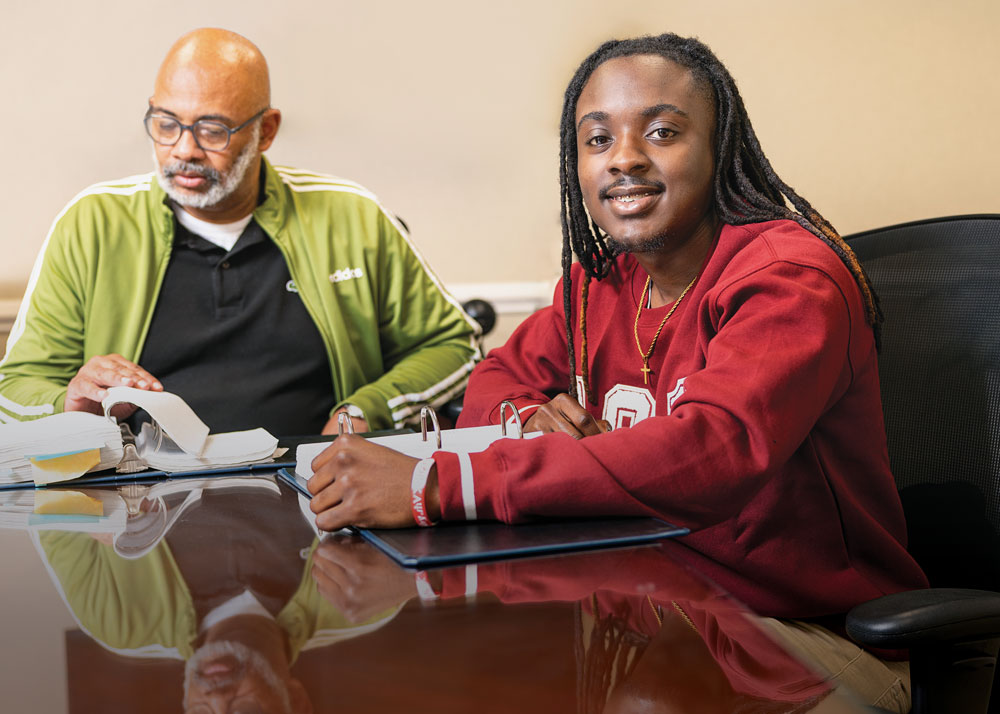
“No room for regret.” That is the motto Kelvin Pearson invokes as he talks about his time at the University of South Carolina. The sophomore political science major is living it out as he prepares for his career as lawyer.
“My mindset is to do what I can with the time I have,” Pearson says.
As a first-generation college student, Pearson wants to make the most of his time at USC. In addition to his classes, he interns for a local law firm, Boykin & Davis, LLC. Pearson is a legal assistant and runner, but he’s not just running for coffee or making copies. He drives important legal documents to courthouses, traveling as far as Clarendon County on occasion to file a lawsuit.
“That’s out by my hometown,” says Pearson, who grew up in Manning. “I came to USC because I grew up in a small town. I wanted to get out of my comfort zone and push myself to do something bigger.”
Pearson is a TRIO Opportunity Scholar. The program offers financial and academic support, with smaller class sizes for freshmen, peer mentorship and tutoring, and career advising. Pearson says the program was also a haven during his freshmen year, when he was still new to the university and dealing with the death of a family member.
“TRIO helped me stay caught up with my classes and provided a lot of comfort,” he says.
Toward the end of his freshman year, Pearson — who describes himself as “the biggest introvert” — decided to reach out to the Boykin & Davis firm and ask for a job.
“I saw one of the partners, Kenneth Davis, went to USC himself, so I sent him a message through their website,” he says. “It was definitely outside of my comfort zone, but I asked myself, ‘What is the risk if it doesn’t work out? And what could be the benefit if it does?’”
The rest is history, and for nearly a year, Pearson has been soaking up all he can from his internship.
“The main thing I’ve learned is that working in law is not like it looks in the movies,” he says, remembering the day he first filed a lawsuit. “I thought it would be this complex process, but it’s not. A lot of times as students, we’re so in awe of lawyers and judges in their suits and robes, but I realized that they’re just regular people doing a job. It’s made me realize that a career in law is in reach.”
Pearson credits his internship with giving him the confidence to seek out new challenges at USC, like his run for Student Senate this spring. Although he doesn’t plan to go into politics, he knows being a senator will give him more valuable experience.
“I thought it would be a good way to get involved in Student Government and give back. The Student Senate makes a real difference for the student body,” he says.
Pearson has also served as a summer orientation leader and will return as Team Lead this year, where he’s looking forward to welcoming another class of freshman to USC. If he had any advice for an incoming student, it would be this:
“Experience is one of the biggest things you can have. A resume is good, but experience is what you need, so get involved and go to those job fairs on campus. Even if you’re not looking for a specific job, go and talk to people. Get your face out there. A lot of the success I’ve had is because I met people.”

Computer science senior Lucy Tyrteos didn’t think her summer internship at Savannah River Mission Completion would turn into a yearlong placement. The Aiken native was one of a few selected for the Technical Student Program at SRMC to work as an apprentice cybersecurity analyst.
“I grew up in Aiken, and the site is something that’s kind of taboo,” Tyrteos says. “We don’t really talk about it because it’s in the same realm as, like, the Manhattan Project. So just being able to go into this big place that’s really historic that not many people ever get to see is exciting.”
Even just going through the security barricade, having her badge checked and entering an office in a high-tech facility is a thrill, though the importance of the job isn’t lost on her. “I know that it’s a privilege and an honor to work there,” she says. “Many people in the generations before me paved the way.”
And the work is excellent on-the-job training for a career in cybersecurity. On any given day, she might be asked to perform vulnerability scans, which identify known security weaknesses, or conduct penetration tests, which use simulated real-world cyberattacks to discover exploitable weaknesses.
“This internship is a little bit different from other internships where you’re not given a lot of responsibility simply because you’re not there for that long,” she says. “I’m given actual tasks and a lot more time to work on them. I’ve already gotten my official badge, and that’s something I’ve never had in other internships.”
She has also bonded with colleagues and sees herself as part of the team.
“I’m still in college, and I’ve gotten a year of experience on the job market that I would never have had if I didn’t do this,” she says. “I’m incredibly lucky to be working at SRMC at my age.”
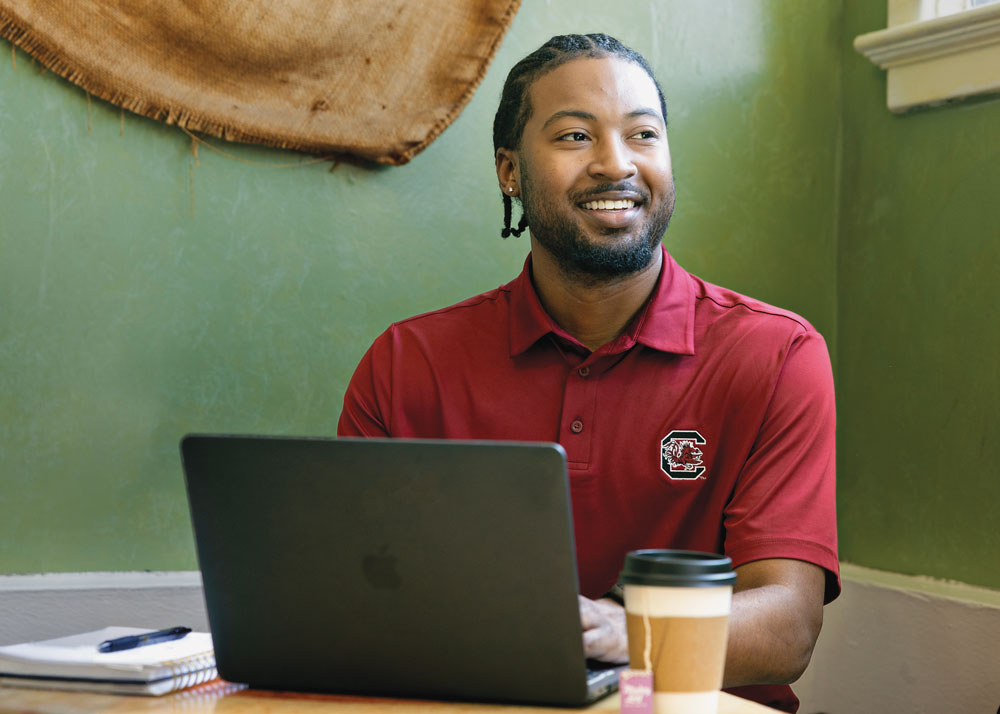
Jakhi Brown started college with big ambitions. The Duncan, South Carolina, native played football and basketball growing up, and he played in the marching band’s drum line at Byrnes High School — because he loved music but also just loved being around sports.
If he could find a job that put him in that world, he’d be happy. And senior year of high school, when he visited the College of Information and Communications at USC Columbia, he found it. “I toured the college,” he says. “Amazing facility. I was blown away, and that’s what I wanted to do at Upstate.”
While he elected to stay close to home for undergrad, it didn’t hurt to look down field. And he could already see the play sequence: Bachelor of Arts in Communications at USC Upstate, internships, experience, job, career. Unfortunately, like a lot of students of his generation, Brown started college at an inopportune moment.
“My first year and a half was during COVID, so I was never on campus,” he says. “I did a whole bunch of classwork and learned the theories, but the experiences I did have were never really tailored toward sports. That’s really what I wanted to do. I just couldn’t break into it.”
Now a graduate student in USC’s College of Hospitality, Retail and Sport Management, he is making up for lost time. And when he interviewed for an internship at the South Carolina Football Hall of Fame this spring, the doors that closed during COVID began to reopen.
“As many questions as they had for me, I had for them,” he says. “I wanted to know more about their ability to help develop younger talent. I wanted to see how my interest would align with their goals and their needs. And we just meshed. It’s been a blessing.”
The Hall of Fame recognizes accomplishments and character on the football field and off. And while forces beyond his control have once again kept Brown out of the office — the Hall of Fame’s headquarters in Greenville are currently being renovated — he has learned how to make things work wherever he plugs in.
On any given day, Brown might be researching the bios of potential inductees, analyzing player statistics or developing a grading rubric for player performance with one of his fellow interns. He also does a ton of outreach, making calls and sending emails as the Hall of Fame ramps up for its April enshrinement ceremony.
“There’s just constant communication. That’s one thing that I’ve learned,” he says. “And a lot of Excel spreadsheets!”
There’s also a lot of opportunity to grow and to apply what he has learned at USC Upstate and in his graduate program at USC Columbia.
“They give you the freedom to say what you’re thinking on a project, like, ‘How do you think this looks? What can we do better?’” he says. “But really, I’m just making sure I do something every single day. There’s no day that something can’t be done, you know?”

Senior Hannah Uptigrove came to USC determined to become a journalist. But after taking the writing for mass communications course, a class that lets students try out a variety of styles, she discovered her passion and talent for public relations.
Her passion has only grown since she began her internship at Flock and Rally, where she’s sharpening her skills as a PR professional.
The job at the local communication and marketing firm marks her first on-site internship and her first chance to see how a PR campaign is put together from start to finish.
“My last internship was also at an agency, but it was remote,” says Uptigrove, who is from Mobile, Alabama. “Getting to be in-person and meet with the people I’m working with has been beneficial.”
And because Flock and Rally works with clients from multiple sectors, she has been able to explore different areas of the industry, including community relations and crisis communications, and use a wide range of skills she learned in her courses at USC.
“We had a client where a lot of my work was in community relations, and it was really cool as a public relations intern to be able to learn more about that,” she says. “Instead of pitching to media outlets, you’re pitching to government officials, figuring out what that looks like, how to navigate. Seeing the differences in wording and tone used in that style of PR versus entertainment PR was a really good lesson.”
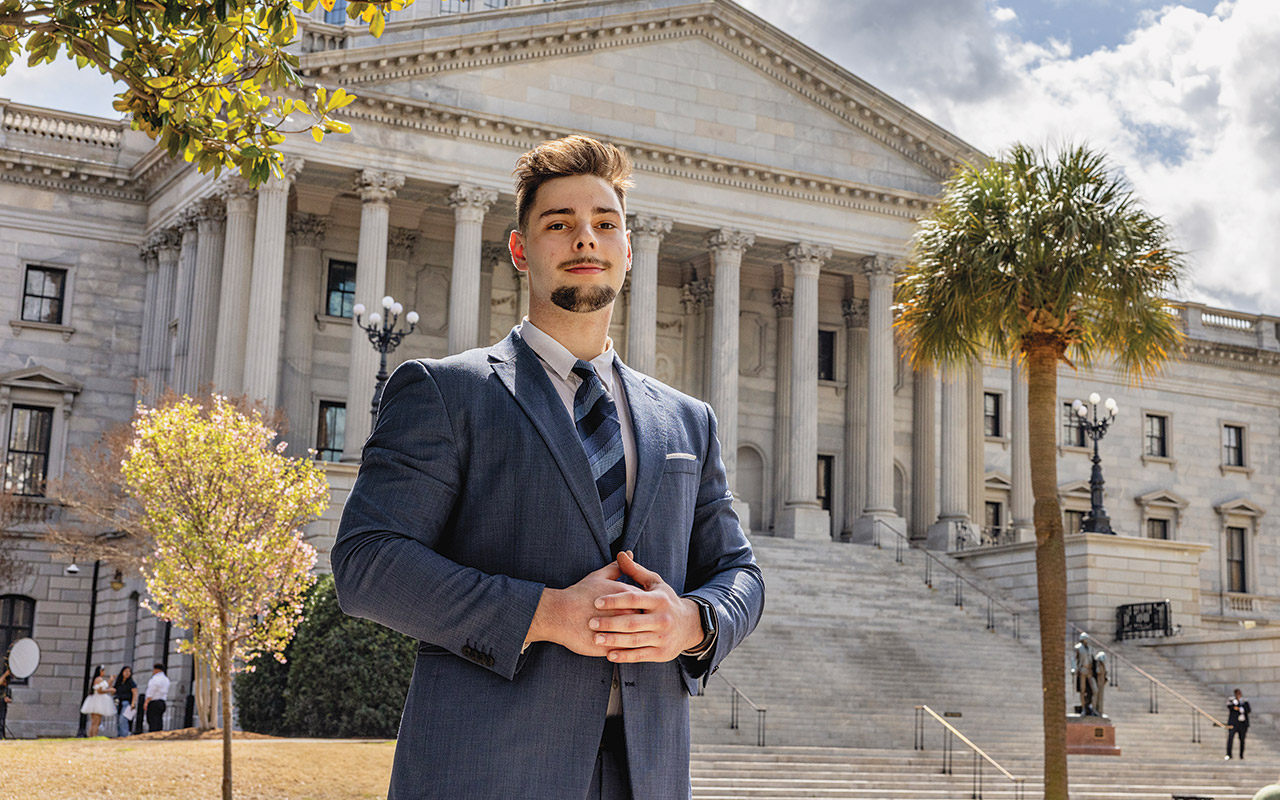
David Kozak likes to be ready for every situation. He’s the kind of person who always has a back-up plan. “And usually, a back-up plan for my back-up plan,” says Kozak, who transferred to the University of South Carolina last fall.
His freshman and sophomore years, he played football in the Northeast10 Conference for the American International College in Massachusetts. After growing up in Hungary, Kozak caught the attention of the Division II team as a teenage player for his country’s highest-performing club team. He came to the U.S. four years ago with two goals: playing football and studying international business.
But academic pursuits were never just a back-up plan for Kozak, and he found he wanted a more challenging environment. That’s why he decided to enroll in the McCausland College of Arts and Sciences as a junior.
“It came it the point where I needed to choose, and I’m really glad that I chose academics,” he says. “I even switched my major to international studies, which focuses more on the legislative and political side compared to business.”
To keep his options flexible, Kozak added a minor in business administration through the Darla Moore School of Business. He’s now working toward becoming a diplomat or lawyer or going into public administration.
“When friends ask me what my perfect job would be, I always tell them the best job in the world for me is getting paid to travel. And the best part is, there is a job for that: It’s called being a diplomat or foreign service officer,” Kozak says.
To prepare for his future career, Kozak has taken an internship for the spring semester with Capitol Information Affiliates in Columbia, an agency that monitors South Carolina’s legislature and other departments. Their clients are organizations and businesses that need help lobbying or getting a seat the table where decisions are being made, making the agency a great fit for Kozak’s interest in both business and politics.
As an intern, Kozak attends meetings of the Legislature and various committees and takes thorough notes. His summaries help the agency keep up with everything happening at the State House, and he publishes reports in the agency’s email newsletter.
For Kozak it’s exciting to be so close to state politics. “It’s a huge networking opportunity. I’m spending my Tuesdays, Wednesdays, Thursdays, sometimes even more, with state representatives, senators and chamber members,” he says.
“I even had a great with the conversation with the Clerk of the House of Representatives, and I can’t ask for anything better than that, because I would love to work in public administration.”
Kozak met the clerk though a political science class he’s taking in conjunction with his internship. Instructor Joshua Meyer-Gutbrod offers a course each fall and spring to support students who have internships with local and state agencies. Sessions feature guest speakers from a variety of fields, like lobbyists and advocacy groups, government officials and state representatives.
“Clerk Charles Reid was the guest speaker at our class one day, and afterward I went up to talk with him,” Kozak says. “I think he saw something in me, because he invited me to meet with him at his office. I’m excited to see where that connection will lead.”
As an international student who has lived away from home through all his adult life, Kozak knows how important it is to build a network. His internship has been just one door that USC opened for him. From his earliest days on campus as a transfer student, Kozak found a supportive community at USC. He joined the Carolina Navigators Christian student group and pledged the Delta Kappa Epsilon fraternity.
“Carolina Navigators has been one of the most impactful groups of my life, and the fraternity is where I found my brothers,” he says.
“USC is an amazing place. As someone who has lived so many places, I appreciate the educational system and the values here in South Carolina. I think I made one of the best decisions to come to USC.”

For retailing sophomore Olivia Branson, being a marketing intern at Alexandra Madison Weddings is a dream come true.
“While I am a retail management major, I’ve always known that I wanted to go into the event planning side
of things,” says Branson, who is from Richmond, Virginia. “And I’ve also always been really interested in digital marketing. I love website
building, using Pinterest and Canva, making collages and just being able to have my
ideas put into one place.”
Though an internship in event planning doesn’t align with her major, she has been able to apply the skills she learned in the classroom, such as website building, while picking up new skills like Excel and marketing techniques.
“I haven’t worked an actual wedding yet, but I have done one event so far, a Valentine’s Day party,” she says. “It was really cool to see everything come together because the entire team goes in and helps set up for parties and events.”
As an intern, she also helps serve food and drinks and then cleans up afterward. That may not seem glamorous, but Branson appreciates the chance to engage with every aspect of the industry.
“Seeing the entire process from start to finish is really rewarding because you’ve worked hard planning the event and then you see it all pay off,” she says. “That’s really exciting for me.”